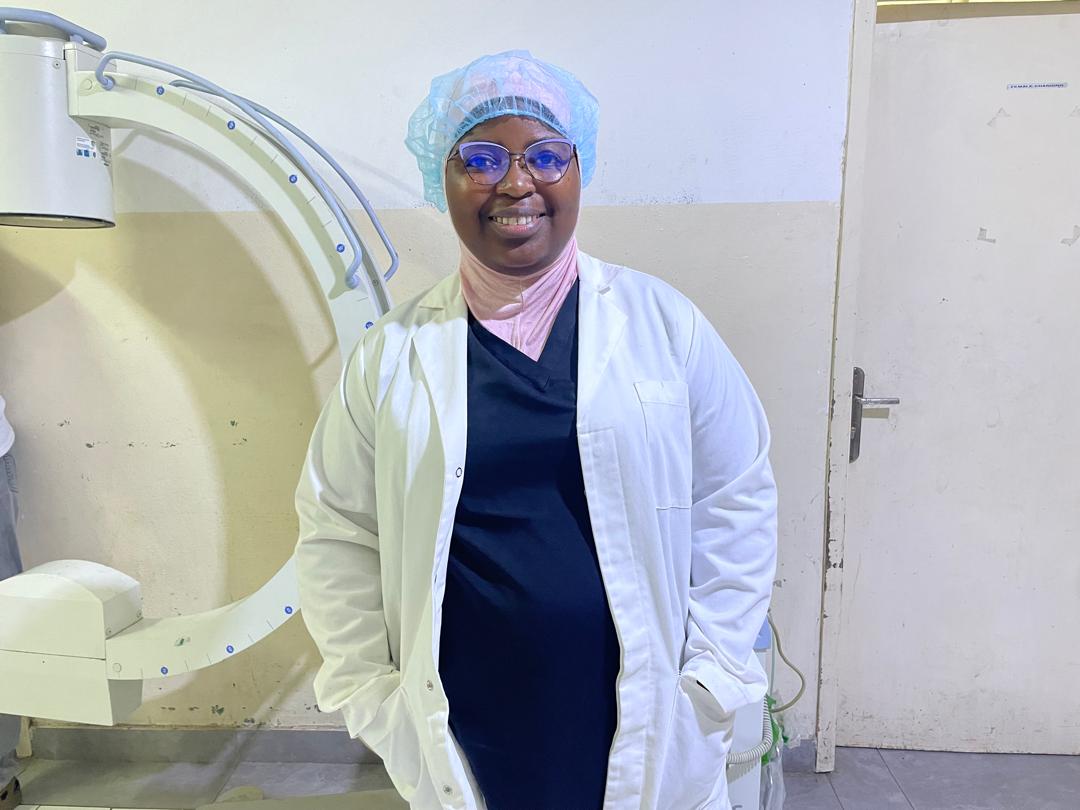
Faculty Profile: Mariama Suso
Mariama Suso: Returning home to strengthen care of the injured in The Gambia
For Mariama Suso, a career in trauma and orthopedic surgery made sense. “I knew I wanted to be a surgeon,” she says. “Orthopedics seemed very practical. It called to me because I’m good with my hands, and I was attracted to the sense behind things—like mechanics, but in medicine.”
Her interest in the specialty was further encouraged by the guidance of mentor Kebba Marenah during her medical training. After completing medical school, Suso undertook two years of internship training at Edward Francis Small Teaching Hospital in Banjul, The Gambia, before pursuing residency training in trauma and orthopedic surgery at Queen Elizabeth Central Hospital in Blantyre, Malawi.
The experience in Malawi proved invaluable. Working in a setting with relatively few surgical trainees gave her extensive hands-on exposure to a wide range of patients and conditions. Beyond the clinical experience, she found important similarities between the healthcare challenges faced in Malawi and those in The Gambia. “It gave me a clearer view of what to expect when returning home,” she explained.
Returning to The Gambia was always the plan. “There is a very high demand for trauma and orthopedic surgeons,” she says. “We only have one trauma center serving a population of around 2.8 million people, with five trauma and orthopedic surgeons. There is also a high burden of injuries, particularly from road traffic incidents. I wanted to come back and work for my people.” Today, Suso serves as a consultant trauma and orthopedic surgeon at Ndemban Healthcare Center in Bakau, where she began working in January 2026.
Resource limitations affect care services across the country, including shortages of both personnel and essential equipment. “Implant availability can be a challenge, and there is only one C-arm machine in the country,” she notes. Another major concern is delayed presentation to hospital. Many patients initially seek treatment from traditional bonesetters and only come to healthcare facilities months later, when their conditions have become complex. “As a result, we see a high incidence of malunions, nonunions, and even amputations, especially in children,” she explains. “These complications have a major impact on quality of life.” Suso sees opportunities for improvement through increased investment in human resources, equipment, and public awareness about the importance of seeking timely care for injuries.
As one of a growing, but still small, number of women in trauma and orthopedic surgery, Suso wants to encourage young women to pursue careers in medicine and surgery.
“If you have an interest in orthopedic surgery or medicine, go for it,” she says. She recalls being told early in her career that surgery was too demanding and would make it difficult to balance professional and family responsibilities as a woman. Her experience has shown otherwise. “You can have both if you want to,” she says. “You shouldn’t have to choose between your career and being a mother or a wife.” Having met many successful female orthopedic surgeons throughout her training, Suso hopes her own journey will help inspire the next generation. “It is definitely possible to have a place in this male-dominated field,” she says.
Through her work at Ndemban Healthcare Center, Mariama Suso is helping address a critical healthcare need in The Gambia while serving as an example of what dedication, specialist training, and a commitment to community can achieve.